

You don’t know it yet, because I haven’t advertised it yet, but the Durandal Solo Mode is already available at DriveThruRpg. So go there and grab your copy! You need the core Durandal book to play, as it has all the extended rules you need, like the rules for character creation if you want to play your own character, but you can also grab the characters from the free Quickstart and use them in your solo adventures.
I’m starting a short series of posts about a solo character I created, and I’ll be posting them here and on social media for you to follow along.
A Gentlemen of the Road style solo hero
For the last few weeks I have been playing with Durandal’s solo rules and the oracle deck. Instead of just waving my hands and saying “you can totally play this solo”, I wanted to show the process from the inside.
So, in this post I will walk through the full creation of a solo character for Durandal, explaining the rules as I go. The result is Zelik ben Yosef, a Jewish wanderer and physician inspired by Michael Chabon’s Gentlemen of the Road.
This follows the core book character creation rules, then leans into the Solo Game for tone and framing.
Step 1, start with a concept
Durandal always starts from fiction, not numbers.
I knew I wanted someone in the spirit of Zelikman. That gave me a few anchors from the start.
Jewish, moving through the wider Carolingian world
Physically unimpressive but extremely capable
Always at the edge of armies and empires, never quite belonging to any of them
A healer and a schemer, more interested in surviving than in glory
From that I wrote a short concept sentence.
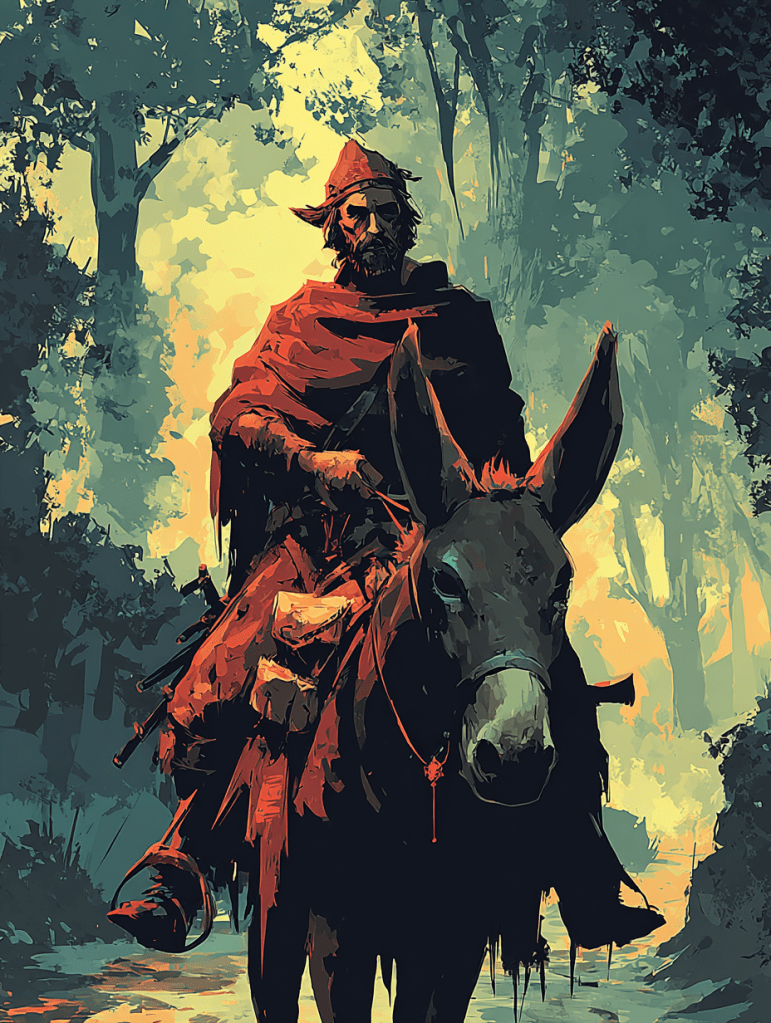
“A thin and sharp eyed Jewish physician who lives out of his saddlebags and his wits, forever riding the borderlands between Frankish, Moorish and Saxon territories.”
Everything that follows has to serve this idea.
Step 2, choose Culture
In Durandal each character starts by choosing a Culture, which gives you flavour, suggested skills and roleplaying hooks. Zelik is clearly from the Jewish communities scattered through the empire, so I picked the Jewish Culture template.
Mechanically, that gives me three things to focus on.
Favoured skills: Lore, Medicine, Negotiation
Cultural tensions: faith versus survival, prejudice, life in diaspora
A sense of “home” that is spread across trade routes and extended family, not one village
When I later assign skill points and Passions, I keep those in mind. Zelik must be educated, medically competent, and very used to talking his way through danger.
Step 3, pick Class and Archetype
After Culture comes Class and Archetype. These are soft categories that suggest what you do in the story rather than locking you to a rigid role.
Zelik is not a knight, not a priest, not a noble. He lives on the road. That is a clear Outsiders and Adventurers Class, with the Wanderer Archetype.
This tells me a few things.
He does not have a formal place in Charlemagne’s hierarchy
He knows roads, border tensions and war camps better than polished courts
His Perks and skills should tilt toward survival, travel and adaptability
At the table, Wanderers are glue characters: they can plausibly appear anywhere, know almost anyone, and leave again without breaking the story.
Step 4, distribute Attributes
Durandal uses three Attributes.
Vigor, physical strength and toughness
Acumen, intellect, perception, cunning
Grace, charm, poise and social presence
You have 6 points to distribute, with a usual range from 1 to 3. Zelik is not strong, but he is sharp and reasonably charismatic, so I went with:
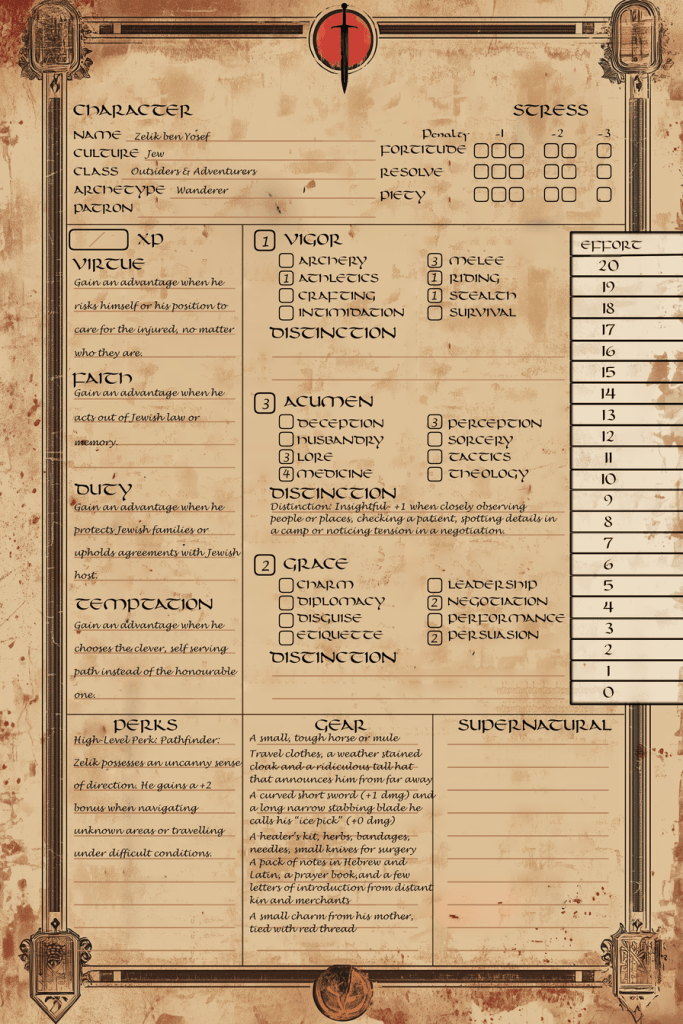
Vigor 1, Acumen 3, Grace 2
This immediately defines his lane. He will never shine in a shield wall, but he will excel at diagnosis, reading situations and talking.
Step 5, choose a Distinction
Each character chooses one Distinction, a short phrase linked to an Attribute that gives a small mechanical edge in specific situations. Distinctions are personality and talent compressed into one line.
Given Zelik’s strong Acumen, I picked:
Insightful
+1 whenever you rely on careful observation and reading the room, whether that is checking a patient, spotting details in a camp or noticing tension in a negotiation.
This Distinction reinforces his role as the one who notices things others miss. In solo play that matters a lot, since the only eyes on the situation are yours.
Step 6, assign Skills
Durandal gives you 20 points to spend on skills. Each skill is rated between 0 and 5. There are separate skill lists attached to each Attribute.
With Zelik’s concept and Culture in mind, I built this spread.
Vigor skills
Athletics 1, Melee 3, Riding 1, Stealth 1
Acumen skills
Medicine 4, Lore 3, Perception 3
Grace skills
Negotiation 2, Persuasion 2
That adds up to 20 points.
The logic is simple.
He needs enough Melee to survive basic trouble, but not to dominate.
Medicine must be excellent, this is his main vocation.
Lore and Perception support his role as scholar and observer.
Negotiation and Persuasion let him thrive in markets and courts as long as someone else is holding the shield.
Remember that in Durandal you spend Effort equal to Attribute plus Skill when you want to push hard, so these numbers also tell you how big a bid you can make in different sorts of scenes.
Step 7, pick a Perk
Perks are bigger mechanical edges, special talents or resources. At character creation you take either one High Perk, or two Low Perks.
For Zelik I wanted one strong, clear focus, so I chose a High Perk that fits his traveller angle.
Pathfinder: Zelik possesses an uncanny sense of direction. He gains a +2 bonus when navigating unknown areas or travelling under difficult conditions.
This Perk makes him exactly the kind of person that always knows where he’s going. At this stage I have no idea where the road is taking him, so I figured a High Perk with a strong influence on someone well travelled would be a good fit.
Step 8, define Passions
Passions are Durandal’s real engine. Every character has Virtue, Faith, Duty and Temptation, each written as a specific trigger. When you act in line with a Passion, you can gain advantages, recover Effort or push the scene harder. When you lean into Temptation, you can get even stronger short term gains at long term moral cost.
Using the Jewish Culture suggestions as a base, I wrote Zelik’s Passions like this.
Virtue
Compassion for the Wounded
He gains the Passion benefit when he risks himself or his position to care for the injured, no matter who they are.
Faith
The God of Abraham Does Not Forget
He gains the Passion benefit when he acts out of Jewish law or memory, whether he is refusing to desecrate a body or standing firm against pressure to abandon his people.
Duty
To the Scattered People
He gains the Passion benefit when he protects Jewish families, upholds agreements with Jewish hosts or uses his skills so his community is not crushed between powers.
Temptation
Bitter Wit and Self Preservation
He gains the Passion benefit when he chooses the clever, self serving path instead of the honourable one.
Mechanically, this gives me clear buttons to press during solo play. Whenever the oracle presents a situation, I can look at these four lines and ask myself which one is being tested.
Does Zelik stay with wounded enemies, or flee with the Franks.
Does he tell the truth to a Christian lord, or twist it to protect a hidden ghetto.
Does he sell vital information to the highest bidder, or hold it back.
Each time I lean into a Passion, the rules reward that choice. The story grows teeth.
Step 9, set Effort and Stress
By default, Durandal characters start with 20 Effort, a pool they bid to overcome challenges. Bid too low, you fail. Bid high, you succeed now but risk running out of strength later.
Zelik starts with:
Effort 20, no Stress yet
Given his Temptation and his overall concept, he is a perfect candidate to accumulate Stress through morally grey survival choices. In the Solo Game, that arc will be entirely in my hands, which feels appropriate for this kind of character.
Step 10, equipment and hooks
Finally, I pick equipment and small details. These are mostly narrative, but they matter enormously for tone.
Zelik carries:
A small, tough horse or mule
Travel clothes, a weather stained cloak and a ridiculous tall hat that announces him from far away
A curved short sword and a long narrow stabbing blade he calls his “ice pick”; the short sword is flavoured from the seax, which gives him a +1 bonus for damage, and the stabbing blade is a dagger, giving him +0 bonus for damage
A healer’s kit, herbs, bandages, needles, small knives for surgery
A pack with notebooks in Hebrew and Latin, a small prayer book, and a few letters of introduction from distant kin and merchants
A small charm from his mother, tied with red thread
On the campaign side, the obvious hook is Isaac the Jew as Patron. Zelik can easily be one of Isaac’s couriers, already tangled in letters, parcels and secrets that cross the whole empire.
How this feeds into solo play
With Zelik written up, I can now sit down with the Solo Game and the oracle cards and push him into the world.
The rules will do the following.
His Attributes and skills tell me how much Effort he can credibly bid in different scenes.
His Distinction and Perk remind me where he shines.
His Passions tell me which choices give him mechanical and narrative weight.
His Culture and equipment give me ready made details whenever the oracle throws something unexpected on the road.
Next post, I will introduce the starting situation I have in mind, draw the first cards and see where Zelik’s bitter wit and reluctant compassion lead him.
If you want to build your own solo character in the same style, you can follow the same steps. Start from a strong concept sentence, let Culture and Passions anchor you, then choose numbers that support that story, never the other way around.
 Se7en Sagas
Leave a comment