

This weekend I finally put Scar City in front of players at Rolisboa.

That mattered more to me than simply testing another adventure.
Scar City began with a fairly specific question: what happens if you take the atmosphere of wartime Lisbon, spies, refugees, cafés, ministries, neutral ground full of people waiting for ships, and turn it into a strange fantasy city where bureaucracy itself has power?
The result is Vezar, a city of seven hills where the dead can still work, old street names can destabilise reality, papers matter more than they should, and the institutions responsible for keeping the City functioning may also be responsible for deciding which truths are allowed to exist.
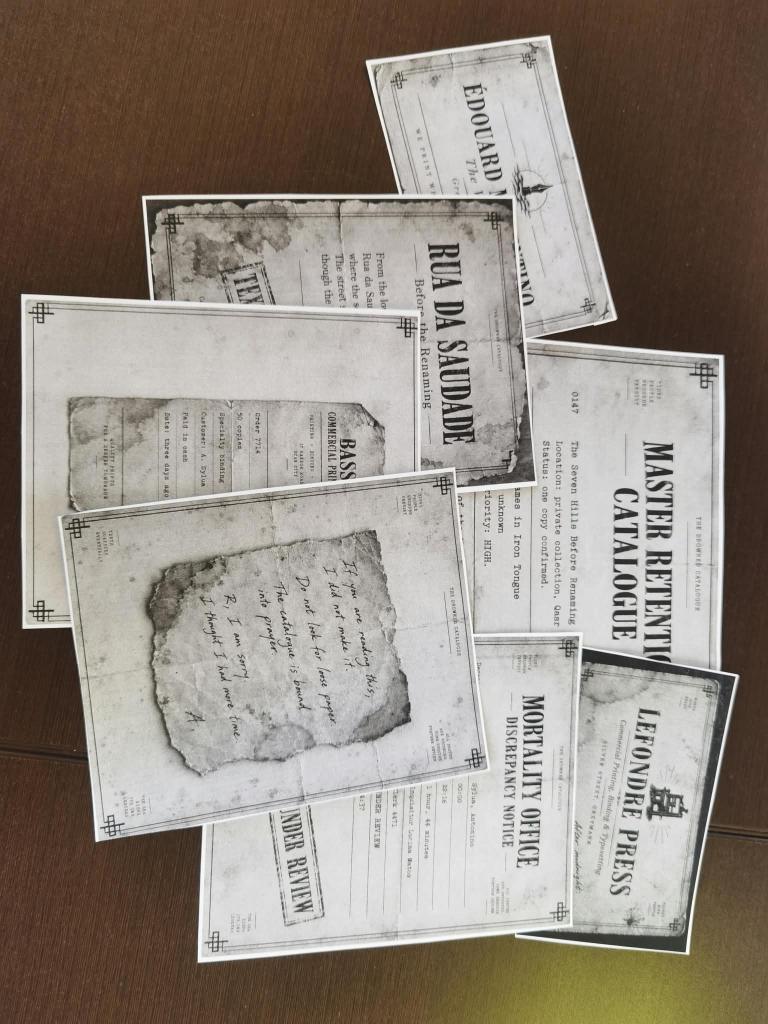
For the playtest I brought The Drowned Catalogue, a noir investigation built around the death of a bookseller called Antonino Sylua.
His car went into the Silver Flow.
The authorities called it an accident.
His widow did not believe them.
From there, things got considerably stranger.
What I wanted to know was not simply whether the adventure worked. I wanted to know whether Scar City itself worked at the table.
It did.
And that was probably the most gratifying thing I could have taken away from the session.
The players immediately engaged with Vezar. They questioned its institutions, followed its strange logic, became interested in the Under, reacted to the Cataloguers, and treated the setting as something worth investigating rather than merely scenery surrounding a D&D adventure.
There were also several moments where the playtest taught me things I could never have learned by continuing to edit the manuscript alone.
The players did not follow the route I had expected.
Good.
They went where the investigation suggested they should go, rather than where my numbered scenes told them to go. That immediately exposed something important about the adventure: The Drowned Catalogue should not be written as a sequence of scenes. It should be written as a case.
Vezar needs to move around the investigators, not wait for them in numbered rooms.
NPCs need their own goals.
Clues need to lead in several directions.
Threats should enter when the fiction demands them, rather than because the party has reached Scene Four.
The Not So Big Bad should pursue her own path while the characters pursue theirs.
The strange things beneath Vezar should appear because the characters have disturbed something, not because the adventure says it is time for the monster encounter.
That is a substantial rewrite.
It is also exactly the sort of rewrite a good playtest is supposed to cause.
There was another lesson.
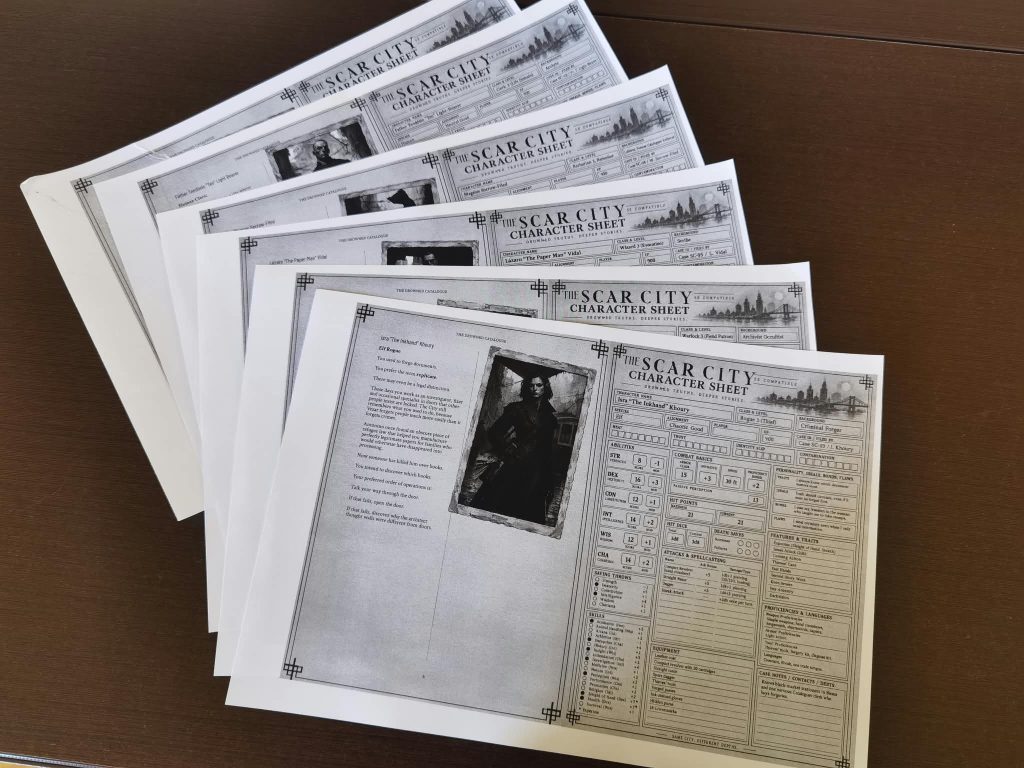
Scar City is currently being developed using Fifth Edition rules, partly because I wanted to see what this kind of setting would look like through the most familiar fantasy RPG system in the world.
During play, however, there were moments that made me question that choice.
A Warlock unleashed an Eldritch Blast capable of doing frightening amounts of damage.
A Cleric restored a significant portion of somebody’s wounds almost immediately.
Both were perfectly normal D&D moments.
They just were not particularly noir moments.
That does not mean I am abandoning the Fifth Edition version. Far too much work has gone into it, and I still want to finish and publish The Drowned Catalogue as a complete playable introduction to Scar City.
But the session gave me something useful to think about as the setting develops beyond this quickstart.
What kind of game should Scar City actually be?
I do not have that answer yet.
That is a good place for a game to be.
Most importantly, though, the setting survived contact with players.
More than survived it.
People wanted to know more.
They wanted to know what existed beneath the streets.
They wanted to understand what the City had forgotten.
They wanted to follow doors that should not be there.
For somebody who spends an unreasonable amount of time inventing imaginary cities, that is about the best result I could have hoped for.
A huge thank you to everyone who played.
Thank you for taking the investigation seriously, for immediately finding routes through it that I had not anticipated, for challenging the assumptions built into the adventure, and especially for giving Vezar a chance.
You helped me see what Scar City needs to become next.
And thank you to Rolisboa.
Events like this matter enormously to small designers. There is a vast difference between reading your own manuscript for the fiftieth time and sitting across from actual people while they decide what your fictional world is worth caring about.
Rolisboa gave me the table, the players and the opportunity to find that out.
I came home with pages of changes to make.
That is a compliment.
While Scar City goes back onto the operating table…
There is another Se7en Sagas game that has already travelled much further down that road.
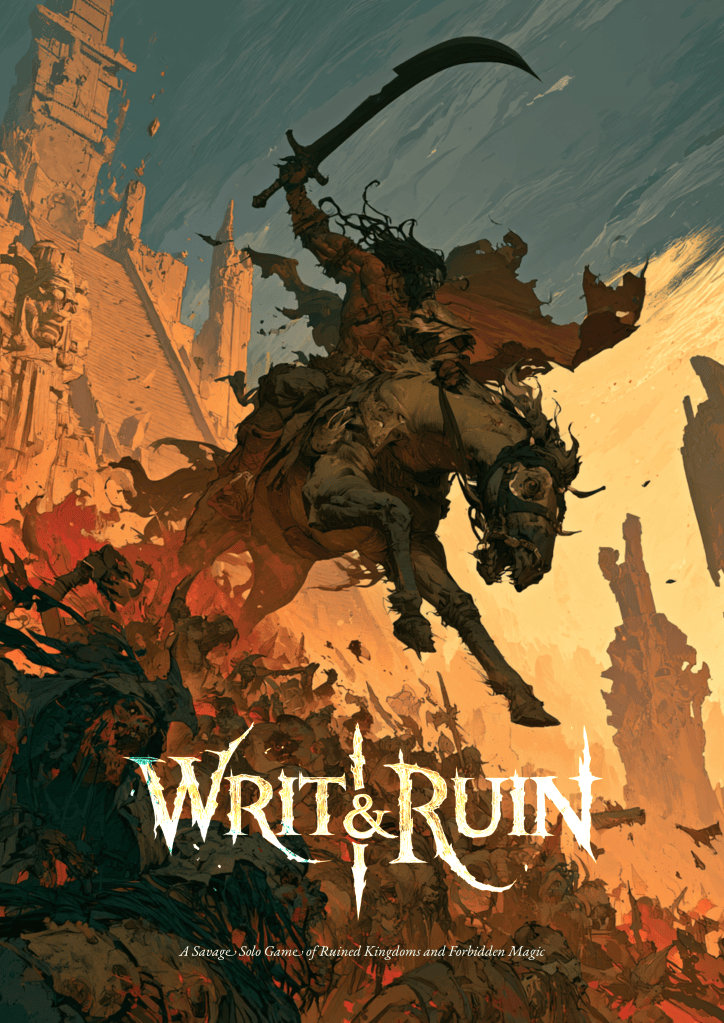
Writ & Ruin is my solo sword and sorcery RPG of savage kingdoms, forgotten gods, dangerous roads and human civilisation surviving beneath the pressure of something much older.
It is brutal fantasy rather than heroic fantasy.
Kings rule fragile territories. Sorcery is dangerous. Roads matter. Names matter. Things wait beyond the borders of human reality.
If the idea of strange worlds, dangerous truths and fantasy that refuses to behave like ordinary fantasy is what brought you here, Writ & Ruin is available now.
Buying it also does something very practical: it helps Se7en Sagas continue producing the next strange game, the next experiment, and eventually the full version of Scar City.
So if you want to support what I am building, pick up Writ & Ruin, leave a review if you enjoy it, and keep an eye on Vezar.
The City is still being filed.
Not everything is going where the Cataloguers expected.


Leave a comment