

What happens when the greatest danger in a fantasy city isn’t a dragon, a demon or an invading army, but the institution that decides whether you exist?
I’ve been working on Scar City for quite some time, and I’m delighted to announce that its first quickstart adventure, The Drowned Catalogue, is now available on DriveThruRPG.
This is a project that began with a simple question: what if we took the familiar rules of Fifth Edition and used them to tell stories that had very little to do with traditional heroic fantasy?
Not another dungeon. Not another kingdom waiting to be saved. Not another ancient evil that can be defeated by reducing its Hit Points to zero.
Instead, I wanted a city of secrets, compromises, impossible histories and people trying to do the right thing when there might not be a right thing to do.
I wanted weird fantasy noir.
And that is how Scar City came to be.
Welcome to Vezar
It is October 1940 CR.
The world stands at the edge of war, and Vezar is a supposedly neutral coastal capital where refugees, spies, diplomats, smugglers and exiles have gathered.
Trams rattle through rain-soaked streets. Hotels shelter people travelling under assumed names. Diplomats negotiate over drinks while intelligence officers listen from the next table. Ministries keep their records impeccably organised, even when those records contradict reality.
Vezar is a city where everyone carries papers.
After a catastrophe known as the Sorting, the City reorganised itself through a process of bureaucratic correction. Streets were renamed. Districts were rearranged. Histories were rewritten.
And reality followed.
Today, the authorities maintain that order through institutions such as the Cataloguers, who don’t merely enforce laws. They enforce categories.
A person can be reclassified. An address can cease to exist. A historical document can become dangerous simply because it remembers something the City has erased.
But some things refuse to remain forgotten.
Beneath Vezar lies the Under, a place of old routes, forgotten names and doors that lead somewhere they shouldn’t.
And somewhere between the official City and the one that still remembers, ordinary people are trying to survive.
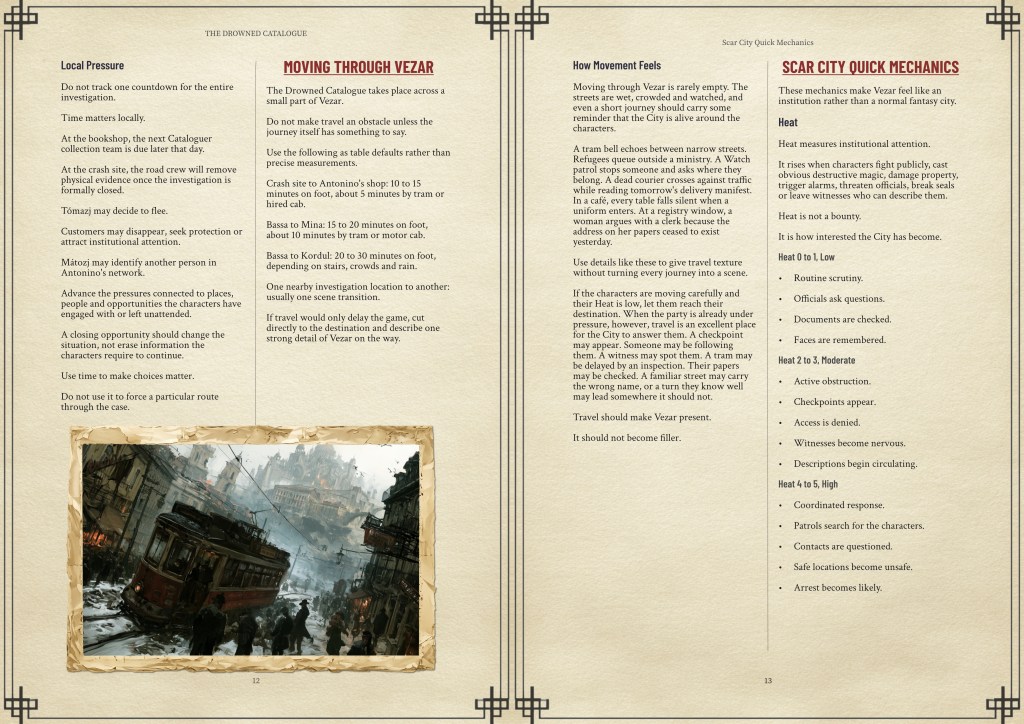
Fifth Edition, But Not Quite as You Know It
I have a complicated relationship with Fifth Edition.
On the one hand, it’s a system familiar to an enormous number of players. Its basic structure is approachable, its character options are extensive, and people can sit down at a table already knowing how most things work.
On the other hand, its assumptions tend to push campaigns toward increasingly powerful heroic fantasy.
There’s nothing inherently wrong with that, of course. But it’s not what I wanted for Scar City.
I wanted investigators who could be capable without becoming invulnerable. Characters who might possess extraordinary powers but still have to worry about witnesses, documents, political pressure and the consequences of making enemies.
So rather than rebuilding the rules from scratch, I kept the familiar Fifth Edition framework and changed what the game pays attention to.
The rules handle what you can do. Scar City handles what it costs.
That philosophy runs throughout the setting.
Heat: The City Notices
In most fantasy adventures, violence is primarily a tactical problem.
In Scar City, violence is also a public event.
Fire a weapon in the street, cast an unmistakably destructive spell, break into a sealed building or threaten the wrong official, and the City begins to notice.
Heat represents institutional attention.
As it rises, witnesses become nervous, records are flagged, checkpoints appear, contacts are questioned and the institutions begin responding to what you’ve done.
The point isn’t to punish players for acting.
It’s to make their actions matter beyond the immediate encounter.
Trust: Who Will Help You?
Investigations depend on people.
A frightened witness might have the information you need but refuse to speak. A clerk might be willing to bend procedure, provided they believe you won’t abandon them afterward. An underground contact might offer shelter, but only if doing so doesn’t destroy everyone else in their network.
Trust measures how far individuals and factions are prepared to risk themselves on your behalf.
It also means that gathering information isn’t necessarily the same as earning someone’s cooperation.
Identity Slip: When the City Forgets You
Some knowledge in Scar City is dangerous because it contradicts the reality everyone has agreed to inhabit.
Read an old text. Speak a forbidden street name. Follow a route that shouldn’t exist.
Something changes.
At first, it might be small. A familiar neighbourhood feels wrong. Your documents seem slightly inconsistent. An official looks at your identification and hesitates.
Eventually, the problem becomes more serious.
You might become someone the City’s systems can no longer categorise.
And in Vezar, being officially unrecognisable can be worse than being wanted.
This is Identity Slip, one of the central supernatural pressures introduced in the quickstart.
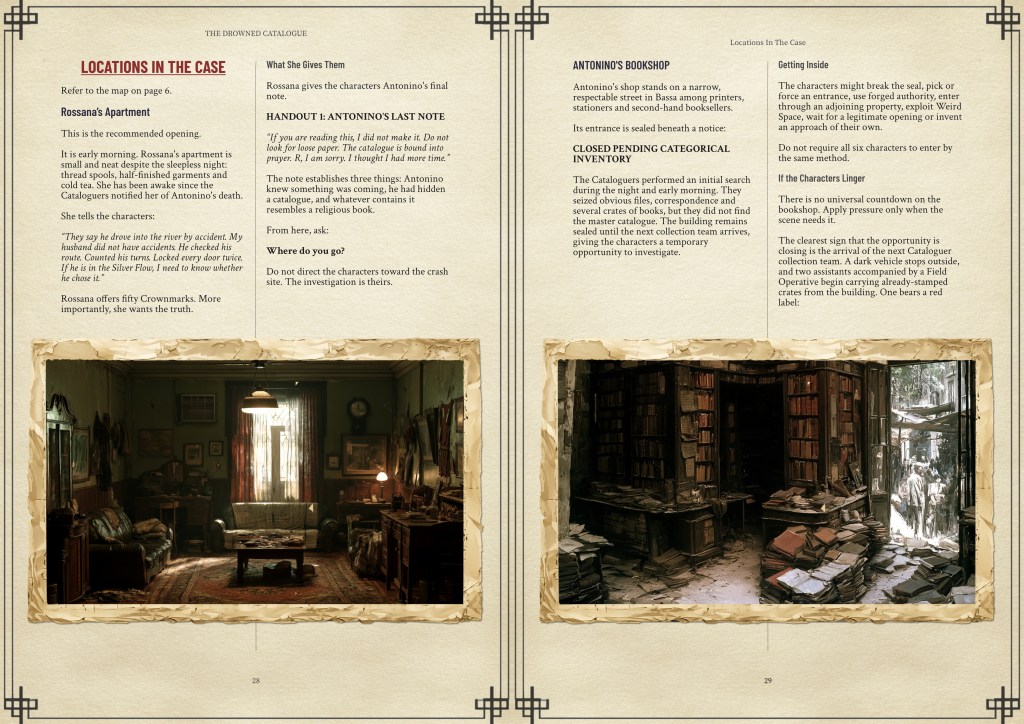
Weird Space: Geography Is Negotiable
Vezar isn’t always governed by ordinary geography.
A corridor might remember an older building. A staircase might lead into a district erased centuries ago. A door might open only for someone who knows a street’s forbidden name.
Weird Space gives the Game Master a way to make the City’s supernatural history tangible.
But it isn’t intended to produce arbitrary confusion.
An impossible doorway should offer a choice. A shortcut might demand a sacrifice. A forgotten route might provide safety while exposing the characters to something much worse.
The strangeness should create decisions, not merely decorate the scenery.
The Drowned Catalogue
Of course, a setting needs more than ideas. It needs something for players to do.
And that brings us to the first Scar City adventure.
The Drowned Catalogue begins with a death.
Antonino Sylua, an antiquarian bookseller, has driven his car into the Silver Flow.
The official report describes an accidental drowning.
His widow, Rossana, doesn’t believe it.
She hires the investigators to discover what really happened.
From there, the investigation can take several directions. There are records that don’t agree, frightened witnesses, missing books, suspicious officials and people who have very good reasons to keep quiet.
The investigators may uncover a clandestine effort to preserve forbidden histories, and discover that some of those histories are dangerous for reasons far stranger than censorship.
But finding out what happened to Antonino is only part of the story.
The greater question is what the investigators will do with what they discover.
And whether exposing a truth is always the same thing as doing the right thing.
An Investigation Without a Predetermined Route
One of the things I particularly wanted to avoid was the familiar investigative adventure in which players must discover Clue A to reach Scene B, succeed at a particular roll to unlock Scene C, and eventually arrive at the finale the writer has already decided upon.
The Drowned Catalogue doesn’t work that way.
The investigation is open. Characters can pursue leads in different orders, divide their attention, seek help from different factions or take approaches I may not have anticipated.
The important people in the case have their own priorities and continue acting while the investigators are elsewhere.
And, perhaps most importantly, an unsuccessful investigative roll shouldn’t prevent the story from moving forward.
If the characters need a clue to continue, failing the roll doesn’t mean they find nothing.
Perhaps they find it, but someone notices.
Perhaps they find it, but waste precious time.
Perhaps they find it, but have to expose themselves to something dangerous in order to understand it.
Failure creates complications rather than dead ends.
The players still get to investigate. Their choices still matter. And the mystery keeps moving.
What’s in the Quickstart?
The Drowned Catalogue is a complete introductory adventure designed for approximately 4 to 5 hours of play.
The release includes:
• A 54-page illustrated adventure booklet, introducing Vezar, its institutions, its supernatural dangers and the case itself.
• Six pregenerated level 3 investigators, each with their own personality, loyalties, flaws and reasons to become involved.
• Eight printable investigative handouts, allowing players to examine notes, records, documents and other evidence directly.
• Additional player and Game Master reference materials, including an introduction to the Scar City mechanics.
• An open investigation with active characters, conflicting interests and a conclusion determined by the players’ decisions.
The quickstart uses Fifth Edition rules, compatible with SRD 5.2.1, so you don’t need to learn an entirely new roleplaying system to play it.
It also introduces a small selection of the mechanics and ideas that will feature in the larger Scar City game.
Why Scar City?
I’ve always been drawn to settings where the world feels larger than the characters, where institutions have weight, history has consequences and the supernatural doesn’t necessarily announce itself with fireballs and tentacles.
There is something particularly unsettling about a system that doesn’t need to hate you to destroy your life.
A clerk might follow procedure perfectly and still ruin someone.
A priest might perform a genuine miracle without knowing whether the institution he serves understands the divine at all.
An investigator might solve a murder and discover that the truth makes everyone less safe.
Those are the kinds of stories I want Scar City to tell.
Stories about people, responsibility, survival and the choices we make when every available answer has a cost.
And I think Fifth Edition, approached from a different angle, can be a surprisingly interesting vehicle for those stories.
Enter Scar City
The Drowned Catalogue is the first invitation into Vezar.
Whether you’re looking for a complete noir investigation to run in an evening, an introduction to a stranger side of Fifth Edition, or simply a city where a missing document can be more dangerous than a monster, I hope you’ll give it a look.
I’m particularly interested in hearing how different groups approach the investigation and what decisions they make when they discover what’s really at stake.
If you play it, I’d love to hear about your experience.
The Scar City: The Drowned Catalogue is available now on DriveThruRPG.
Get The Drowned Catalogue on DriveThruRPG
Thank you, as always, for supporting Se7en Sagas and independent tabletop roleplaying games.
Welcome to Vezar.
Keep your papers in order.
The City is watching.
Rui Anselmo
Se7en Sagas


Leave a Reply